
The CX concept I defined in 2013… and why it matters more now than ever. Originally published in 2013. Updated in 2026 because the concept hasn’t changed, but the world it operates in has.
Loyalty has one test. Would the people you serve choose you… not because they have to, not because you are the only option or the cheapest one… but because of what you mean to them? If the answer is yes, you have loyalty. If you are not sure, you probably don’t.
That is sacrificial loyalty. It is a simple idea. It is also, in my experience, a surprisingly rare one.
The concept travels well. A water utility might see it in customers who follow water-conservation guidelines during a drought… going beyond what is required, because they trust the institution asking. A hospital earns it when patients choose a more expensive insurance plan specifically to ensure access to that hospital, even when equivalent clinical care is available elsewhere for less. And in the UAE, during the regional conflict of 2026, residents who had the means and their own governments’ encouragement to leave chose to stay… because they trusted what their government was saying and doing. That is sacrificial loyalty in its clearest form. A free choice, made under pressure, in the face of an easier alternative.
I first defined this concept in 2013. Since then I have applied it across industries, geographies, and organisation types… commercial, public sector, NGO. Customers, citizens, patients, members, beneficiaries. The competitive landscape has shifted dramatically in that time. The concept has not needed to. What has changed is how many more ways organisations have found to confuse the appearance of loyalty with the real thing, and how much more exposed that confusion leaves them.
The three false proxies
CX practitioners spend enormous energy measuring and managing things that feel like loyalty but aren’t. Three in particular deserve scrutiny.
Retention rate. A customer who renews their subscription because cancelling takes forty minutes on hold is not loyal. They are trapped. Retention measures presence, not commitment. The day a competitor makes switching effortless, you will discover which of your retained customers were ever actually yours.
Loyalty programmes. Points, tiers, and rewards create switching costs dressed up as appreciation. A customer accumulating airline miles isn’t loyal to the airline… they’re invested in the programme. Remove the programme, and the relationship evaporates. Worse, research consistently shows that rewards-based “loyalty” attracts the customers least likely to sacrifice for you.
NPS. A customer who gives you a 9 and recommends you to a friend is valuable. They are not necessarily loyal. Satisfaction and loyalty are related but distinct. A satisfied customer stays when things are good. A loyal customer stays… and defends you… when things are not. NPS measures satisfaction and advocacy. It does not measure sacrifice.
None of these metrics are useless. All of them, if treated as evidence of loyalty, leave the organisation dangerously overconfident about the depth of customer commitment it actually has.
Tenure is not loyalty. But it can mask its absence.
The phone companies found this out when their markets deregulated. Pharmaceutical firms discovered it when blockbuster drugs lost patent protection. Public institutions have found it when citizens finally gained a credible alternative… or simply lost faith. Now watch it play out in streaming: a decade of content lock-in has produced subscriber bases with almost no sacrificial loyalty. When prices rise, customers calculate. When a rival improves, they migrate. Tenure was mistaken for loyalty for years. The churn data corrects the record.
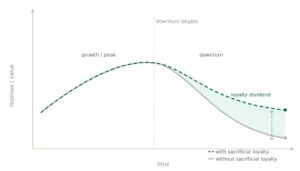
The competitive landscape does not stay constant. Organisations that attend only to tenure underestimate their risk precisely when that risk is rising. Sacrificial loyalty is the buffer. It is what keeps customers riding out the storm with you rather than leaving the moment a credible alternative appears.
The only way to know if you have sacrificial loyalty is to remove the excuses. Friction masks the absence of loyalty… it does not replace it.
This is why… counterintuitively… making it easier for customers to leave is often the most honest diagnostic available to a CX leader. When switching is frictionless, customers who stay are making a visible, uncoerced choice. That act of choosing, repeated freely, is what builds real psychological commitment. Lock-in never lets customers discover whether they’d choose you. So when lock-in ends, there is no loyalty muscle there. Only exposed tenure.
Competitive advantage and the premium customers pay
Any organisation can establish competitive advantage by being better, faster, or cheaper. Successful ones generally do it by offering two at once. The third is the premium the customer pays… and it is where sacrificial loyalty lives.
- Better and faster will not be cheap. The customer pays a price premium.
- Faster and cheaper will not be better. The customer pays a quality premium.
- Better and cheaper will not be faster. The customer pays a speed premium.
Organisations that do not want to… or cannot… compete on price should pay particular attention. Sacrificial loyalty is not optional for you. It is the only sustainable competitive position available. If customers are with you because you are better and faster, the premium they pay is price. They are knowingly sacrificing a cheaper alternative. That sacrifice, made willingly, is the loyalty you are building.
What AI gets right… and what it misses
Hyper-personalisation at scale is genuinely impressive. AI can now anticipate a customer’s needs before they articulate them, resolve friction before it registers as frustration, and deliver relevance that would have required an army of relationship managers a decade ago. That capability is real and worth building.
But there is a category error quietly spreading through CX functions right now: the conflation of efficiency loyalty with sacrificial loyalty. AI is extraordinary at the former. It has not cracked the latter.
A customer who stays because the AI experience is seamless and frictionless is not the same as a customer who stays because they feel genuinely known, valued, and part of something worth sacrificing for. The first churns the moment a competitor’s AI is marginally better. The second does not.
There is a further risk. Some of the human moments that historically generated emotional loyalty… the service recovery call, the agent who remembered your context without being prompted, the interaction that surprised you with its warmth… are being automated away in the name of efficiency. This is not an argument against automation. It is an argument for being deliberate about which moments carry emotional weight and protecting them accordingly.
The question to ask of every AI-driven CX initiative is not “does this reduce friction?” It is “does this build or erode the emotional investment that makes a customer willing to sacrifice?”
Community: the loyalty multiplier you cannot manufacture
The most durable sacrificial loyalty is not built between a customer and a brand. It is built between customers… with the brand as the context in which it happens.
When customers become part of something larger than the transaction… a community, an identity, a shared set of values… the calculus of switching changes entirely. Leaving is no longer just a commercial decision. It is a social one. Peloton riders are not loyal to a piece of exercise equipment. Patagonia customers are not loyal to a jacket. Harley-Davidson owners are not loyal to a motorcycle. They are loyal to what they become as part of those communities, and that loyalty is largely self-generating. The brand cultivates the conditions; the community does the rest.
Social proof has always influenced purchasing. What has changed in the past decade is that digital community infrastructure has made it possible to build these contexts at scale and to make them visible. CX practitioners who understand sacrificial loyalty should be asking not just “what is our customer’s relationship with us?” but “what is our customer’s relationship with other customers… and are we cultivating that?”
The inversion that changes everything
Most organisations approach customer experience from a position of implicit generosity. We provide the service. We deliver the value. We try to make the experience a good one. The customer, in this framing, is the recipient.
Sacrificial loyalty inverts that entirely. When a customer chooses you in spite of a better alternative… pays more, waits longer, stays through a difficult period, trusts you under pressure… they are giving you something. Time. Money. Patience. In some cases, as we have seen, considerably more than that. The organisation is the recipient of that gift. Not the other way around.
This is not a semantic distinction. It changes what you notice, what you feel responsible for, and what you consider unacceptable. A customer who waited forty minutes on hold and didn’t leave gave you something. A patient who chose the more expensive plan to stay with your hospital gave you something. A resident who stayed when they could have gone gave you something.
The question is not whether your customers are satisfied with what you gave them. It is whether you are worthy of what they gave you.
Qaalfa Dibeehi is a Customer-Led Transformation Strategist, author, and keynote speaker. Founder of Human2outcome and former VP and Principal Analyst at Forrester Research. Former Dean of the Majid Al Futtaim Leadership Institute and Board Director at the Customer Institute. He has worked with organisations across Europe, North America, the Middle East, Africa, and Asia on customer experience, behavioural science, and customer-led transformation.